
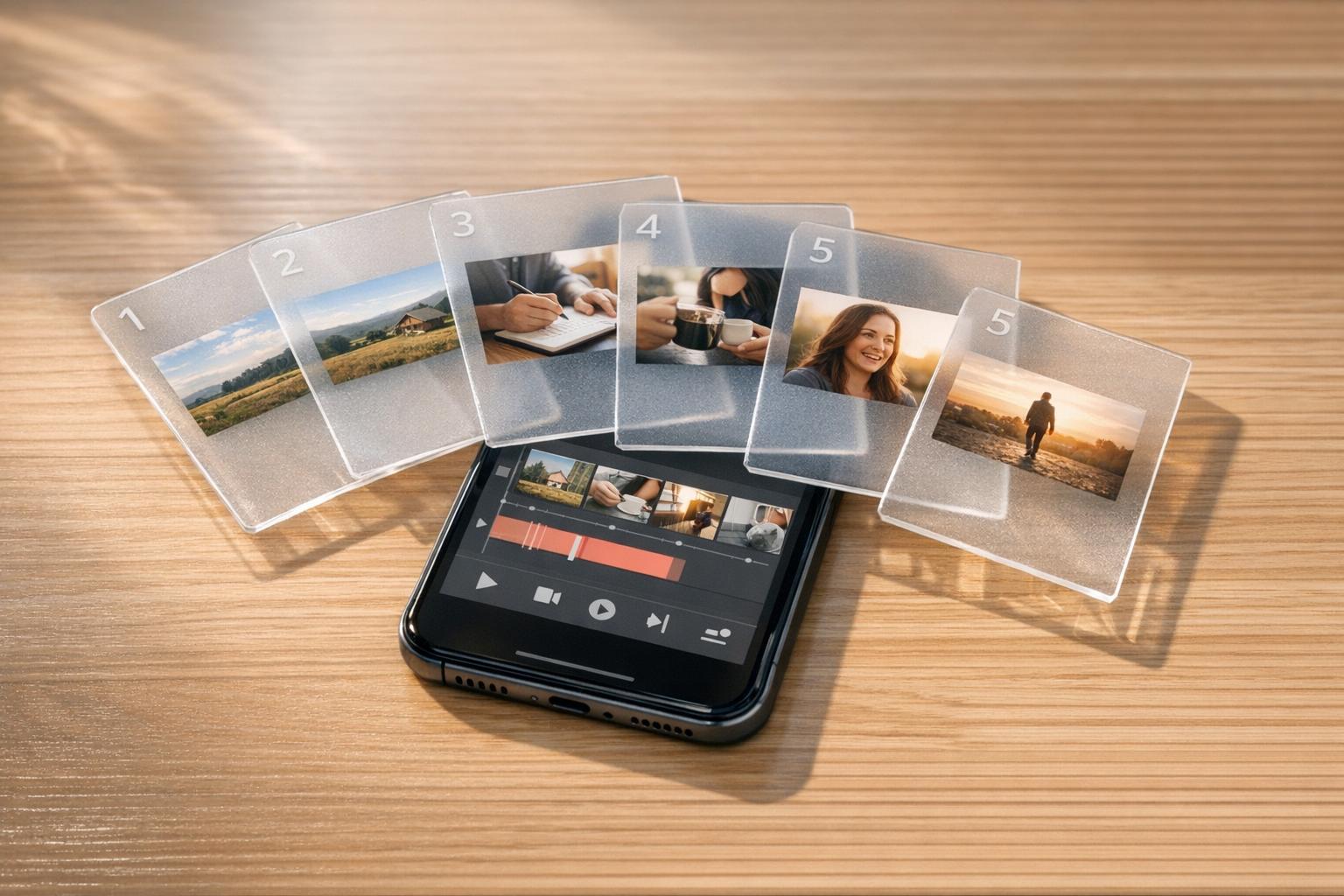
The 5-shot method is a simple framework for creating engaging short videos. It uses five specific shots to tell a story:
- Close-up of hands: Focuses on the action or task.
- Close-up of face: Highlights the subject’s emotion or identity.
- Wide shot: Shows the setting or environment.
- Over-the-shoulder shot: Provides the subject’s perspective.
- Unusual or low-angle shot: Adds variety and visual interest.
This approach is widely used for platforms like TikTok, Instagram Reels, and YouTube Shorts. It helps capture attention quickly, keeps viewers engaged, and improves watch time - key metrics for social media success.
Quick tips:
- Keep shots short (1–3 seconds).
- Start with a strong hook.
- Use captions and audio for clarity and impact.
Planning and shooting these five shots ensures a smooth workflow and consistent content, making it easier to produce viral TikTok content and videos that perform well across platforms.
The 5-Shot Method: A Complete Visual Storytelling Framework for Short Videos
Visual Storytelling With the 5-Shot Method for Video Sequences
sbb-itb-3858882
Breaking Down the 5 Shots
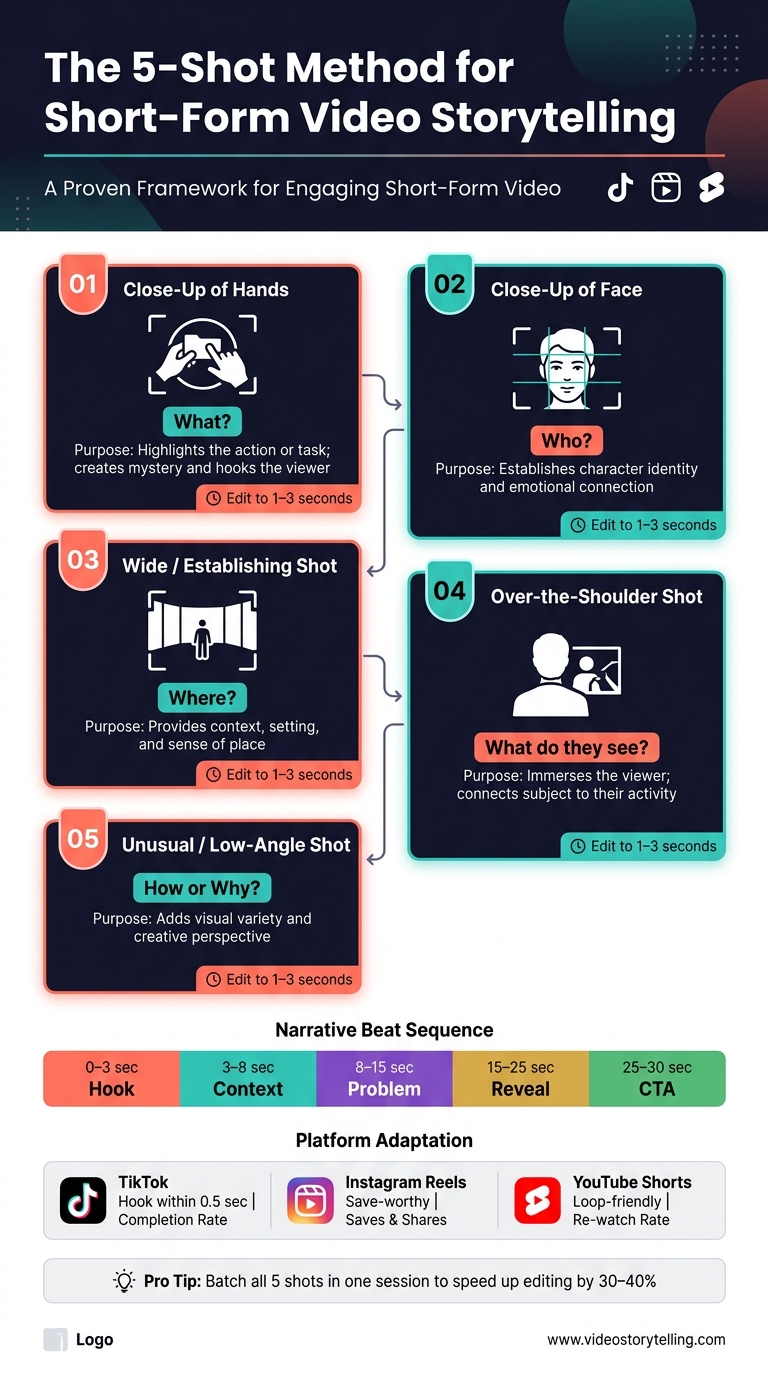
Each of these five shots serves a distinct purpose in storytelling, answering key narrative questions and guiding viewers step by step.
| Shot Type | Storytelling Question | Primary Purpose |
|---|---|---|
| Close-Up of Hands | What? | Highlights the action or task |
| Close-Up of Face | Who? | Establishes character and emotion |
| Wide / Establishing Shot | Where? | Provides context and setting |
| Over-the-Shoulder | What do they see? | Connects subject to the action |
| Unusual / Alternative | How or why? | Adds visual interest and extra detail |
Let’s dive into each shot with practical tips for framing and execution.
Close-Up of Hands
This shot zooms in on the action, focusing entirely on the task being performed. It skips context and identity, creating an air of mystery that hooks the audience. As media co-op explains:
"Starting a film with this shot intrigues the viewer - we know what's being done, but who is doing it? Where? Why?"
To make this effective, frame tightly around the hands and use a shallow depth of field to blur the background. Aim to shoot at least 10 seconds of footage, then edit it down to a concise 3–5 seconds.
Close-Up of Face
Here’s where the story answers who. This shot introduces the subject and builds an emotional connection through facial expressions and eye movement. Pulitzer Traveling Fellow Ashley Elizabeth Miller captures its essence:
"Grab an artful shot of the subject's face. Maybe their eyes are down, looking at their hands moving with emotion - capture that. Make sure, as with all shots, it carries your story forward."
For best results, follow the rule of thirds by aligning the subject’s eyes along the upper horizontal grid line instead of centering them. Watch for headroom - too much space above the head can feel awkward and unbalanced.
Medium or Wide Establishing Shot
This shot answers where. It pulls back to show the subject in their environment, giving viewers a sense of place. Author Marie Gardiner explains its importance:
"An establishing shot... should give a sense of place and set the tone for the scene. It's often the first shot in a sequence, and you can think of it as answering the fundamental questions of 'Where are we?'"
This perspective is especially useful for showing movement or posture, adding context to the scene.
Over-the-Shoulder Shot
The over-the-shoulder (OTS) shot immerses the viewer by showing what the subject sees. Framed from just behind the subject’s head and shoulder, it connects the person to their activity. Including part of the shoulder or head in the foreground adds depth, making the frame feel layered and textured. Without this foreground element, the shot can lose its immersive quality.
Remember to stick to the 180-degree rule to maintain spatial consistency during editing.
Unusual or Low-Angle Shot
This shot is your chance to get creative. It could be a low-angle perspective looking up, a reflection in a mirror, an extreme close-up of an object, or even an overhead view. The goal is to add variety and enhance the narrative with a fresh perspective. Choose a shot that complements the story while keeping the momentum intact.
Next, we’ll explore how to sequence and edit these shots to craft a compelling narrative.
How to Sequence and Edit the 5 Shots
Ordering the Shots for Clarity and Flow
To create a clear and engaging narrative, arrange your shots in a logical progression. A tried-and-true sequence for tutorials or process-oriented content goes like this: hands (action) → face (emotion) → medium shot (who and where) → over-the-shoulder (perspective) → wide or unusual angle (full scene). This order moves from detailed to expansive, offering viewers a natural sense of discovery. Think of each shot as answering a question raised by the one before it.
You can also align your sequence with five key narrative beats: Hook (0–3 seconds), Context (3–8 seconds), Problem (8–15 seconds), Reveal (15–25 seconds), and CTA (25–30 seconds). By matching your shots to these beats, your story begins to take shape almost effortlessly. Once the sequence is set, the focus shifts to editing for short-form platforms.
Editing for Short-Form Platforms
For platforms like TikTok and Instagram Reels, fast pacing is essential. Keep each shot between 1–3 seconds to maintain high visual energy.
Start by creating a "spine cut" - a rough assembly of your footage in sequence to test the narrative flow. If the story doesn’t work in this bare-bones version, no amount of flashy effects or trending audio will save it. Once the spine feels solid, use J-cuts and L-cuts to make audio transitions seamless. Also, ensure that faces and text appear centered in the 9:16 frame to avoid interference from platform UI elements like captions or buttons.
"Slow moments in a short-form video are not just aesthetically weak, they are functionally damaging. When a viewer loses the sense that a video is progressing, the swipe reflex takes over." - Brand Vision
After locking in the visual rhythm, enhance the story with audio and captions.
Adding Audio and Captions
Once your visuals are polished, audio and captions take the narrative to the next level. These aren’t just extras - they’re integral parts of the storytelling process. For voiceovers, balance background music between -18 to -12 LUFS, and lower it by 3–6 dB beneath the dialogue to keep speech clear while maintaining atmosphere. Syncing your edits to the beat of a trending audio track can also boost engagement on TikTok.
Captions are crucial, especially with so many U.S. viewers watching on mute. Use text overlays to emphasize key points rather than simply transcribing dialogue. Bold text hooks should appear within the first 1.5–3 seconds to grab attention, and all text should stay centered in the 9:16 frame to avoid being obscured by platform UI elements.
Using the 5-Shot Method in Marketing
Marketing Use Cases for the 5-Shot Method
The 5-shot method is a great way to tell a complete story, especially on short-form platforms. For product demos, you can structure your video using a marketing-specific narrative arc: Hook (3–5 seconds), Problem (5–8 seconds), Demo (8–15 seconds), Proof (5–8 seconds), and CTA (3–5 seconds). This step-by-step approach keeps viewers engaged as they follow the story from start to finish, with each moment visually compelling.
One effective strategy is to focus on the outcome right at the start. For instance, instead of showing the process first, begin with the result. A skincare brand might lead with a close-up of radiant skin before showing the product application. This instantly grabs attention and highlights the transformation.
The method’s visual diversity also works well for behind-the-scenes content, product launches, or day-in-the-life series. These formats give audiences a sense of authenticity and connection. By following this framework, creators can seamlessly integrate storytelling into their content production.
Batch Production for Consistent Output
The 5-shot method shines when used in batch production, making it easier to maintain a steady flow of content. A smart approach is to shoot all scenes in one location before moving to the next. For example, film all indoor shots first, then move outdoors. This ensures consistent conditions and avoids interruptions. To give editors more flexibility, record 10-second takes and trim them down to 3–5 seconds later. These extra seconds, or "handles", allow editors to choose the best moments. This organized workflow can speed up editing by 30–40% compared to an unstructured process.
Consistency is key when producing a batch of videos. Use a "locked tokens" checklist to ensure uniformity in elements like wardrobe (e.g., "navy sweater, no logos"), lighting (e.g., warm 3200K), and camera settings (e.g., 50mm lens). Additionally, label your footage as soon as you import it - categorizing clips by shot type (e.g., hands, face, wide shots) will save time and reduce confusion during editing.
Strengths and Limitations
While the 5-shot method has many advantages, it also comes with challenges. Here's a breakdown:
| Aspect | Strengths | Limitations | Suggested Fix |
|---|---|---|---|
| Planning | Provides a clear roadmap, avoiding overwhelm | May feel too rigid for complex narratives | Use the 5 shots as flexible building blocks and storyboard to stay on track |
| Shooting | Guarantees enough B-roll for smooth editing | Changes in lighting or weather can disrupt continuity | Batch by location and rely on locked tokens for lighting and wardrobe |
| Editing | Simplifies assembly since much of the story is pre-cut | Micro-expressions might not match voiceovers | Record 10-second takes; use speed ramps or micro-cuts to adjust pacing |
| Marketing | Encourages concise storytelling, boosting completion rates | - | - |
Keeping Up with Platform Trends
Following Platform-Specific Best Practices
Platform algorithms are always evolving, and keeping your strategy aligned with these changes is crucial. Your tried-and-true 5-shot framework is a solid foundation, but it needs to stay flexible to adapt as viewer habits and platform dynamics shift.
Each platform values different user behaviors. For example, TikTok focuses on completion rates. To grab attention, you need to hook viewers within the first 0.5 seconds using bold visuals or on-screen text. On the other hand, Instagram Reels prioritizes saves and shares. Structuring your 5-shot sequence as a mini-tutorial or checklist-style video can encourage users to save it for later. Meanwhile, YouTube Shorts rewards re-watch loops, so designing your final shot to visually connect back to the first can keep viewers engaged and help the algorithm push your content further.
Recent data highlights how quickly things change. Instagram's spring 2025 algorithm update revealed that 3-second retention is now the key ranking factor for reach. In fact, 71% of viewers decide whether to stay or scroll within the first three seconds.
To maximize your content's potential across platforms, consider filming multiple hooks (5–7) and several calls-to-action (CTAs). This modular approach allows you to create platform-specific versions of your videos without needing a complete reshoot. From a single session, you can produce dozens of variations tailored to different platform preferences.
| Platform | Primary Ranking Signal | Key 5-Shot Adaptation |
|---|---|---|
| TikTok | Completion Rate | Add a text hook within the first 0.5 seconds; keep pacing casual and native |
| Instagram Reels | Saves & Shares | Frame content as educational entertainment; ensure visual clarity |
| YouTube Shorts | Re-watch Loops | Make the final shot loop visually back to the first |
For more tips on staying ahead of these trends, check out the next section on leveraging AdWeek.
Using AdWeek to Stay Informed
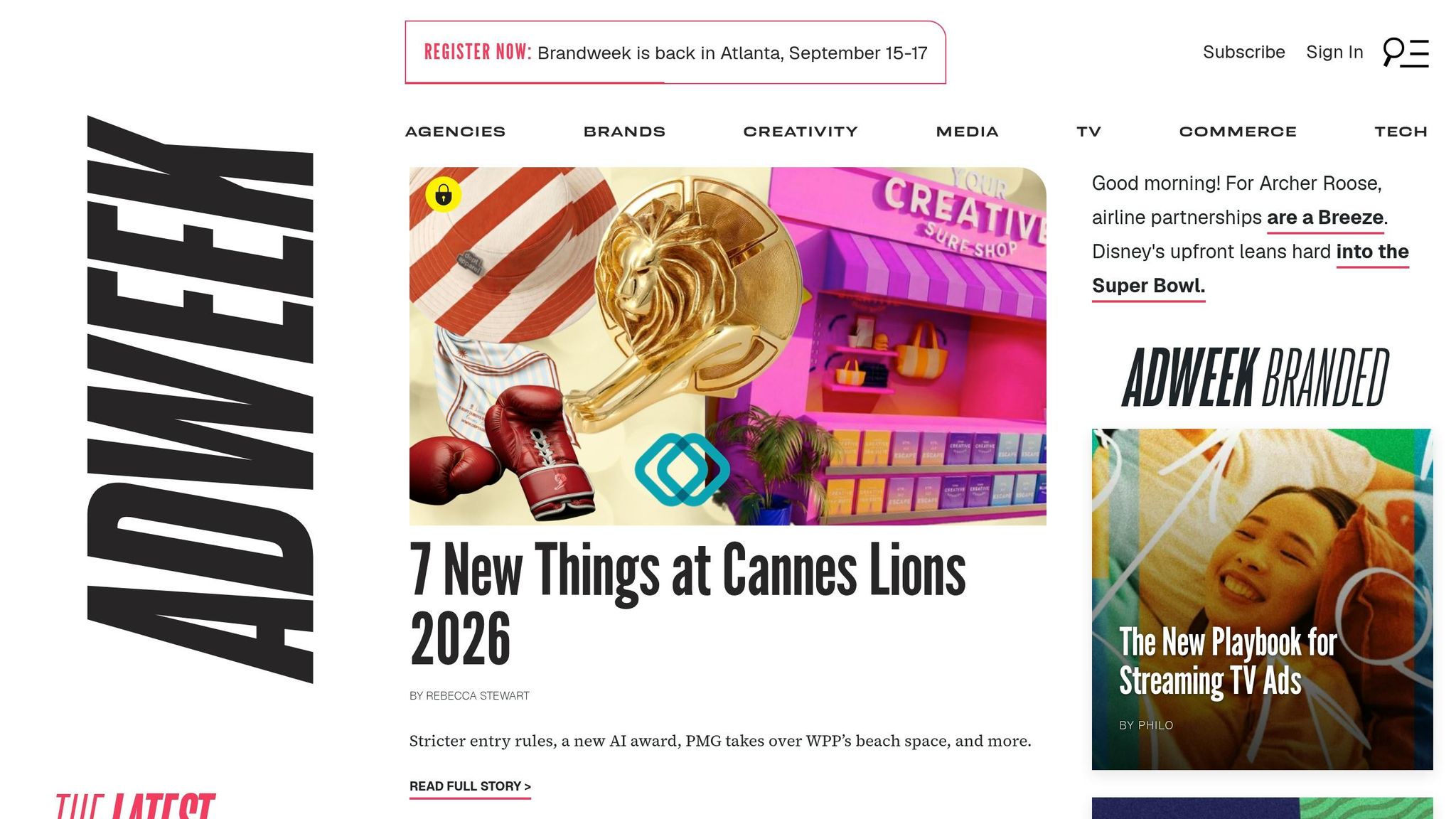
Staying current with platform trends can feel overwhelming, but tools like AdWeek simplify the process. AdWeek provides real-time updates on platform changes, campaign strategies, and insights from industry leaders, giving you the practical knowledge to refine your content strategy.
Take Dunkin's 2024 Super Bowl TikTok campaign as an example. AdWeek showcased how Dunkin' extended its campaign by creating 14 different "continuations", including selling branded tracksuits. This approach kept the campaign engaging well beyond its initial ad slot, earning it the third-highest TikTok effectiveness score that year. This case study demonstrates how a modular creative approach can drive success on a large scale.
"Social cuts matter. To make them more effective, they need to be interrogated just as hard... understand how users behave and make them TikTok-y." - Barney Worfolk-Smith, Chief Growth Officer, DAIVID
AdWeek's free daily newsletter is a great resource for staying informed without having to track every update yourself. Whether it's TikTok's shift to 4,000-character captions for SEO in 2025 or Instagram's latest ranking signals, having a reliable source like AdWeek ensures you're ready to adapt your 5-shot workflow before your engagement metrics take a hit.
Conclusion
The 5-shot method offers a straightforward way to create visually engaging short-form videos by using five key shot types. It introduces a natural flow to your content without making the production process overly complex.
As Shruti Shekar explains:
"The five-shot sequence gives you a plan that is flexible enough to let you adapt fluidly but with enough structure to keep you on track."
This balance is critical for platforms like TikTok, Instagram Reels, and YouTube Shorts, where viewers decide within seconds whether to keep watching. A strong hook paired with a well-organized sequence can make all the difference in holding their attention.
To get started, try creating one complete 5-shot sequence this week. Edit it for your primary platform and observe how your audience responds. As you get comfortable, streamline your process by batching filming sessions and tailoring the content for different platforms from a single shoot.
Staying current with platform updates is equally important. Websites like AdWeek provide free insights into algorithm changes, creative trends, and campaign strategies. Regularly checking resources like this will help you adapt your 5-shot workflow and keep your content fresh and engaging as social media evolves.
FAQs
Can I change the order of the 5 shots?
Yes, you can switch up the order of the five shots. The fifth shot, often referred to as "Your Choice", gives you the freedom to include a different shot that fits the story you're telling. This flexibility helps keep your narrative engaging and tailored to your creative goals.
How do I use the 5-shot method for product marketing?
The 5-shot method is a simple yet powerful way to tell a product story through video. It involves capturing five distinct shots that work together to create an engaging narrative:
- Close-up of hands: Start by showing hands interacting with the product. This immediately draws attention to how the product is used.
- Close-up of the user's face: Next, focus on the user's expression to convey emotion or reaction.
- Wide shot: Pull back to show the environment or context where the product is being used.
- Over-the-shoulder shot: Highlight how the product fits into the user's routine or activity.
- Unique angle or detail: End with a creative shot that emphasizes a standout feature or detail of the product.
Keep each shot brief - around 3 to 5 seconds - to maintain the viewer's attention and effectively showcase the product. This method ensures your video feels dynamic and visually interesting.
How do I make a 5-shot video loop on YouTube Shorts?
The key to a perfect 5-shot video loop on YouTube Shorts lies in making the ending flow right back into the beginning. This creates a seamless experience that encourages viewers to rewatch, boosting both retention and engagement.
Here’s how to make it work:
- Plan Your Sequence Carefully: Map out all five shots so they naturally transition from one to the next. Each shot should feel like it belongs, building up to that final moment.
- Connect the End to the Start: Your last shot should visually or contextually tie back to the first. This could mean repeating a specific action, using a similar visual element, or even revisiting a key theme.
- Use Thematic or Visual Cues: Whether it’s a recurring object, color scheme, or motion, these cues help the loop feel intentional and satisfying.
By focusing on flow and connection, you’ll create a video that keeps viewers watching - and rewatching.


![Outfame Review – The Best Instagram Growth Service in 2026 [TESTED]](/cdn-cgi/image/fit=contain,format=auto,width=null/https://cdn.prod.website-files.com/67840d1d88a886f29a66a4c1/699476a6ce95840f57a98e14_outfame-homepage.png)































![Top 7 Best Instagram Growth Services in 2025 [RESULTS]](/cdn-cgi/image/fit=contain,format=auto,width=null/https://cdn.prod.website-files.com/67840d1d88a886f29a66a4c1/6795d12917ee4501b9eddf73_6795c731964f791db3b566c4-1737870861582.jpg)
![UpGrow Review – The Top Instagram Growth Service in 2026 [UPDATED]](/cdn-cgi/image/fit=contain,format=auto,width=null/https://cdn.prod.website-files.com/67840d1d88a886f29a66a4c1/6795040db42e404207732526_6794fd9c964f791db3b48de9-1737818779111.jpg)